
Everybody in transformation now agrees that green dashboards lie.
It has become one of the safest observations in the field. Milestone completion sits at 94%, every workstream reports amber-green, and operating margin has not moved in two years. The board sees control. The people doing the work see something else entirely.
What almost nobody does is say what should replace it.
That is the more useful question, and it is the one this piece answers. Because a dashboard is not a moral failing. It is an instrument, and it is measuring exactly what it was built to measure: whether activity is proceeding as planned. The problem is that nobody ever asked it whether the business was changing, and it was never designed to know.
Why Rag Status Behaves The Way It Does
A status colour is a judgement, made by a person, about work they are accountable for, reported upward to someone who controls their budget and their prospects. Every part of that sentence explains the outcome.
Green is not a lie. Green is what a reasonable person reports when the alternative is a difficult conversation they do not yet have the evidence to win. The signal degrades a little at each layer, not through dishonesty but through the entirely rational softening that happens when bad news is expensive to deliver. By the time it reaches the top, the distortion is systemic and invisible.
So the fix is not to demand more honest reporting. It is to ask for numbers that a person cannot colour in.
The Executive Five
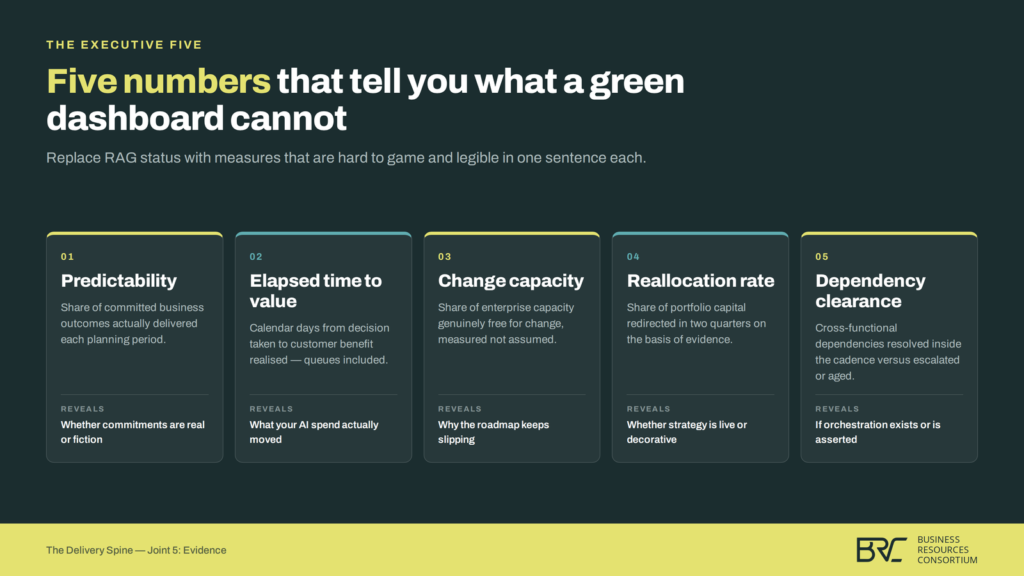
These are the five measures worth putting in front of an executive committee. Each one is legible in a single sentence, each is hard to game, and each reveals something that status reporting structurally cannot.
Predictability.
The proportion of committed business outcomes actually delivered in each planning period. Not milestones — outcomes. The useful band is roughly 80 to 100%. Consistently above that and the teams are sandbagging their commitments, which means you have no idea what they could really do. Consistently below 60% and the commitments are fiction, which means planning is theatre and every downstream date is guesswork. What makes this measure valuable is that it is about the reliability of the promise rather than the size of it, and reliability is what an enterprise actually needs in order to sequence anything.
Elapsed time to value.
Calendar days from a decision being taken to a customer experiencing the benefit. End to end, including every queue, every approval, every batch and every release window. This is the number that most organisations have never measured once, and it is the number that AI investment is supposed to move. Measure it before and after and you will usually discover that a tool made one step dramatically faster while the total barely shifted, because the waiting was never the tool’s problem to solve.
Change capacity.
The proportion of enterprise capacity genuinely available for change, measured rather than assumed. Most roadmaps are built on an assumption in the region of 30%. When it is actually measured — incidents, unplanned work, regulatory obligations, the endless small pull of running the business — the real figure is very often under 15%. This single number explains more roadmap slippage than every delivery failure combined, and no amount of pressure closes the gap, because the arithmetic was wrong before anyone started.
Reallocation rate.
The proportion of portfolio capital redirected in the last two quarters on the basis of evidence. If the answer is close to zero, the funding model is annual and the strategy is decorative — because a strategy you cannot fund differently in response to what you learn is not a strategy, it is a forecast. This is the measure that most directly tests whether governance has any teeth.
Dependency clearance.
Cross-functional dependencies resolved inside the planning cadence, versus those escalated or quietly aged out. This is the honest test of whether orchestration exists or is merely asserted. Every organisation says it manages dependencies. Very few can tell you how many were identified last quarter, how many were resolved in the forum designed to resolve them, and how many are still sitting there because no single person had the authority to settle them.